PULSE ARENA / CHART METHOD 1.4 / 2 OCTOBER 2026
Play the groove of the record.
A reference-first arrangement for Bad Guy. The aim is a satisfying, repeatable gesture that follows audible accents. It does not have to reproduce a guitar, bass or vocal part.
The concrete change
The former chart followed the syncopated bass almost continuously. Strong intervening full-mix accents were absent. The new chart uses a repeating eight-beat gesture: pulse, accent, bass pickup, accent, then repeat. The four pads follow 1–3–2–4 / 1–3–2–4, alternating left and right thumbs. This is an authored gameplay pattern; pad position no longer claims to represent pitch.
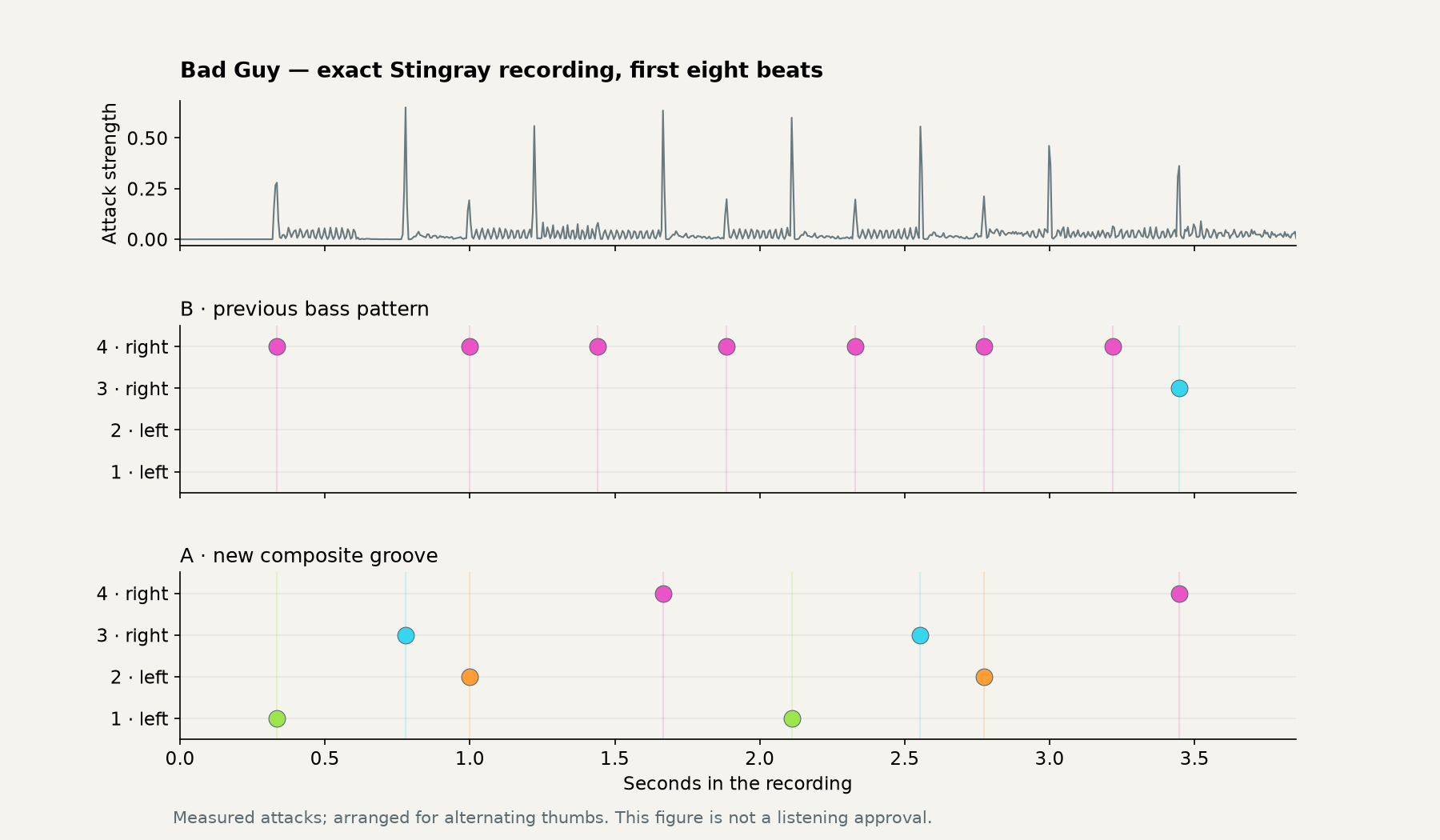
The reference covers 0–14.5 seconds, with 32 taps and no holds. It adds clear accents at 0.778, 1.666, 2.110 and 2.554 seconds, among others. The previous version did not have notes near those accents. The same gesture is applied to nine matched phrases: 283 measured groove attacks replace 297 bass-hook notes. The complete chart has 342 notes, down from 356. Existing vocal passages and the slow outro remain unchanged; this pass makes no new approval claim for them.
Reproducible method
- Bind the source. Use one exact licensed audio recording and its pitch-MIDI. Reject mismatched song ID, audio hash, MIDI hash or parent version. Never copy timestamps from another performance.
- Write a gameplay intention. Choose the accents a player should anticipate. Record which part leads each section, where rests belong, and when a part switch is allowed. A composite groove is valid when the pattern stays understandable.
- Choose a 10–20 second reference. Use a recognizable section with clear attacks and a repeat. Start with music plus neutral clicks; a synthesized melody can distract from the intended rhythm. Keep the previous chart for a direct comparison.
- Author a small gesture. For this pilot, beats
0, 1, 1.5, 3, 4, 5, 5.5, 7within each eight-beat block. Alternate thumbs, leave breathing space and avoid unnecessary holds. These beat choices are song-specific, not a universal recipe. - Require audio evidence. In this recording, short-window spectral novelty locates each selected attack within ±35 ms of its predicted position. The recipe requires novelty ≥0.08 and local strength ratio ≥0.35. Every reference note must be supported. These thresholds are signal-specific and must not be treated as perceptual accuracy or blindly reused for quieter recordings.
- Lock and compare repeats. Save the measured reference offsets. Transport the whole pattern using the existing local phrase anchors and tempo scales; only snap inside the bounded window. Preserve the lane gesture. A phrase needs at least 90% supported events; missing attacks become documented rests. Do not fill gaps with invented metronome notes.
- Validate structure. Check minimum 160 ms spacing, at least 100 ms after holds, section ownership, recording bounds and exact preservation of untouched MIDI/outro material. Regenerating with identical inputs must produce byte-identical chart and evidence files.
- Listen and play before approving. Compare A and B from the same range at normal speed, then inspect at 75% if needed. Review every exception and transition, and play with two thumbs while looking at the TV. Record perceived early/late, unwanted/missing accents and awkward gestures separately. Only human listening/device approval can close those gates.
Repeat coverage
Coverage means that a matching signal attack was found. It is not a score for how good the music feels.
| Phrase | Start | Supported notes | Coverage |
|---|---|---|---|
| 1 | 0.334 s | 32 / 32 | 100.0% |
| 2 | 14.557 s | 32 / 32 | 100.0% |
| 3 | 28.780 s | 30 / 32 | 93.8% |
| 4 | 42.997 s | 32 / 32 | 100.0% |
| 5 | 60.777 s | 32 / 32 | 100.0% |
| 6 | 89.222 s | 30 / 32 | 93.8% |
| 7 | 103.445 s | 32 / 32 | 100.0% |
| 8 | 121.220 s | 32 / 32 | 100.0% |
| 9 | 135.442 s | 31 / 32 | 96.9% |
Explicit rests to review
- 41.885 s: no-local-attack. Leave a rest.
- 42.559 s: weak-local-attack. Leave a rest.
- 102.327 s: weak-local-attack. Leave a rest.
- 103.001 s: weak-local-attack. Leave a rest.
- 149.235 s: no-local-attack. Leave a rest.
A / B review in the application
Open Bad Guy in the chart lab and load the recording. The reference preset is selected automatically. Play A plays the active groove version; Play B plays the previous bass version. Both use the same range, playback speed and listening mode. The buttons load the saved originals; local drafts are kept separately and can be resumed by selecting the arrangement again.
Review presets include the first repeat, two uncertain transitions and the outro boundary. The chart lab now connects as a live host, so an active review no longer expires after one minute because no TV was connected. Normal five-minute inactivity closure still applies, and playback time remains reported to Stingray.
Saved production artifacts
charts/2333720-groove.recipe.json stores the intention, gesture, thresholds and reference. charts/2333720-groove-v3.json is the active chart. charts/2333720-groove-v3.evidence.json records reference attacks, every emitted groove note, coverage and exceptions. charts/2333720-touch-v2.json is the preserved comparison.
python scripts/build-groove-reference.py \
  --recipe charts/2333720-groove.recipe.json \
  --parent charts/2333720-touch-v2.json \
  --evidence ../catalog-evidence/2333720 \
  --phrase-audit charts/catalog-quality-v2.json \
  --out work/2333720-groove-v3.json \
  --report work/2333720-groove-v3.evidence.json
npm test
npm run check
The evidence folder comes from the existing licensed catalog import and contains source.json and features.npz. Analysis needs the packages in scripts/requirements-charting.txt. No audio, MIDI, signed media links or API credentials are included in this report.
Scaling to additional songs
Reuse this workflow and evidence format, not Bad Guy’s beat pattern. For each new song, define a recognizable reference and arrangement intention, obtain a listening-approved example, then expand to matching sections. Keep exceptions visible. A new song, a new recording or a different musical section must not inherit approval from this pilot. Start with one reviewed reference per distinct section type before a full-song sign-off.