PULSE ARENA / METHOD 1.5 / 2 OCTOBER 2026
25 more tracks.
One traceable review per recording.
The playable library now contains 31 songs. This batch adds 10,103 measured taps across 25 full recordings. Each song has its own source fingerprints, numerical features, reference gestures, exception log, inspection notes and chart-lab review passages.
Approval status: playtest. Source inspection, waveform inspection, source binding and simulated scoring are complete. These checks do not establish perceived rhythm quality. Independent listening and physical phone/TV playtesting remain open for all 25 songs. We cannot yet claim that every new song feels as good as the previous reference track.
What each of the 25 passes did
- Find the exact title/artist in the authorized Stingray catalog and check full audio, lead vocal and pitch-MIDI availability.
- Temporarily download the full AAC with lead vocals and pitch MIDI; compute separate SHA-256 fingerprints. Decode the actual recording duration. Retain numerical features, not the source audio file.
- Inspect MIDI phrase starts and the full-mix attack signal. Treat catalogue BPM as a search prior; a default 120 BPM MIDI header does not set the song's clock.
- Fit eight-beat phrases to the recording. Select reference gestures within local 32-beat regions. Repeat their hand positions and measured microtiming; allow ternary subdivisions for Believer and half-time on faster tracks.
- Emit only measured attacks within 35 ms of the transported gesture, with sufficient local strength and contrast. Missing cues become logged rests. Four lanes describe an alternating-thumb gesture; they do not claim isolated instrument pitch.
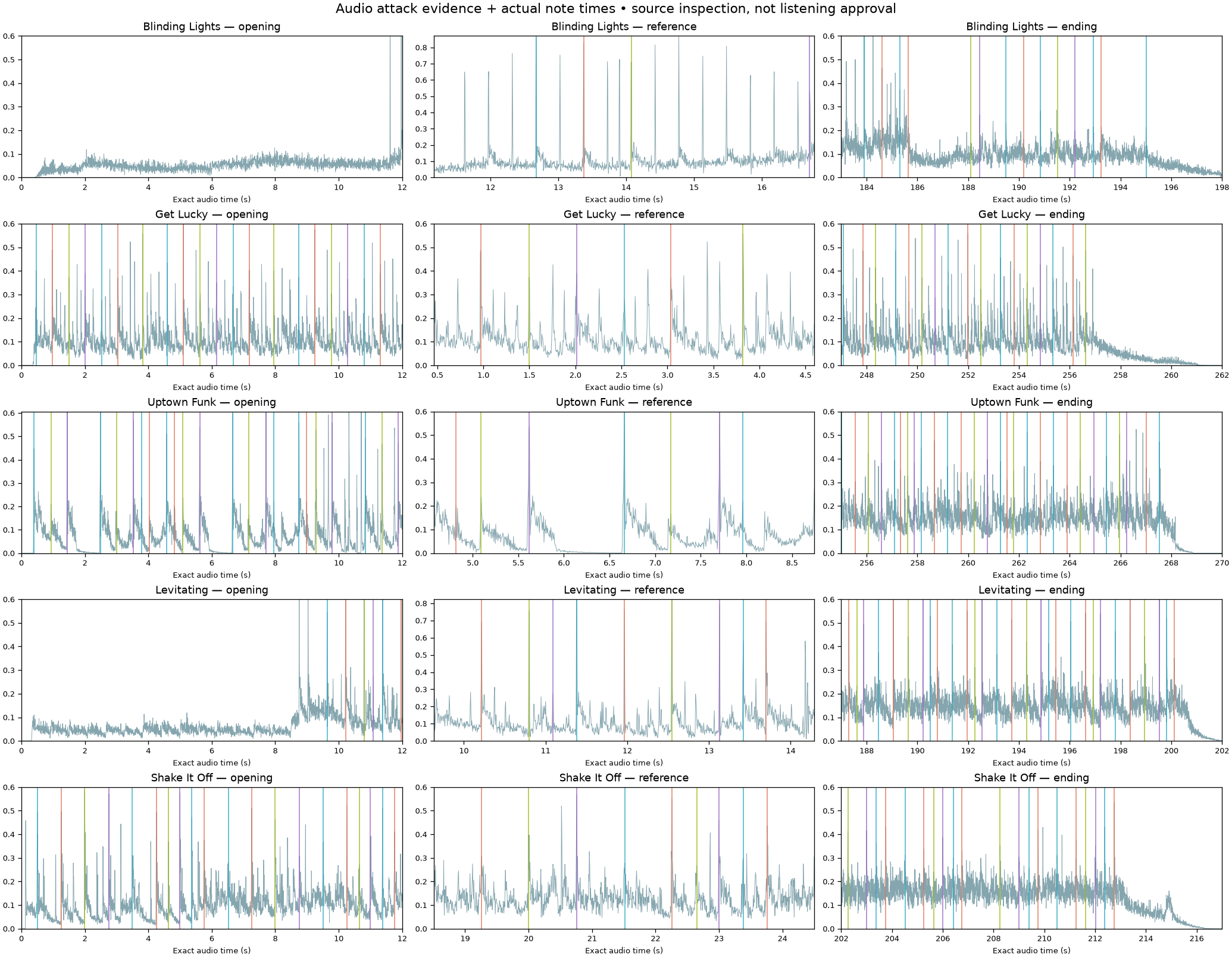
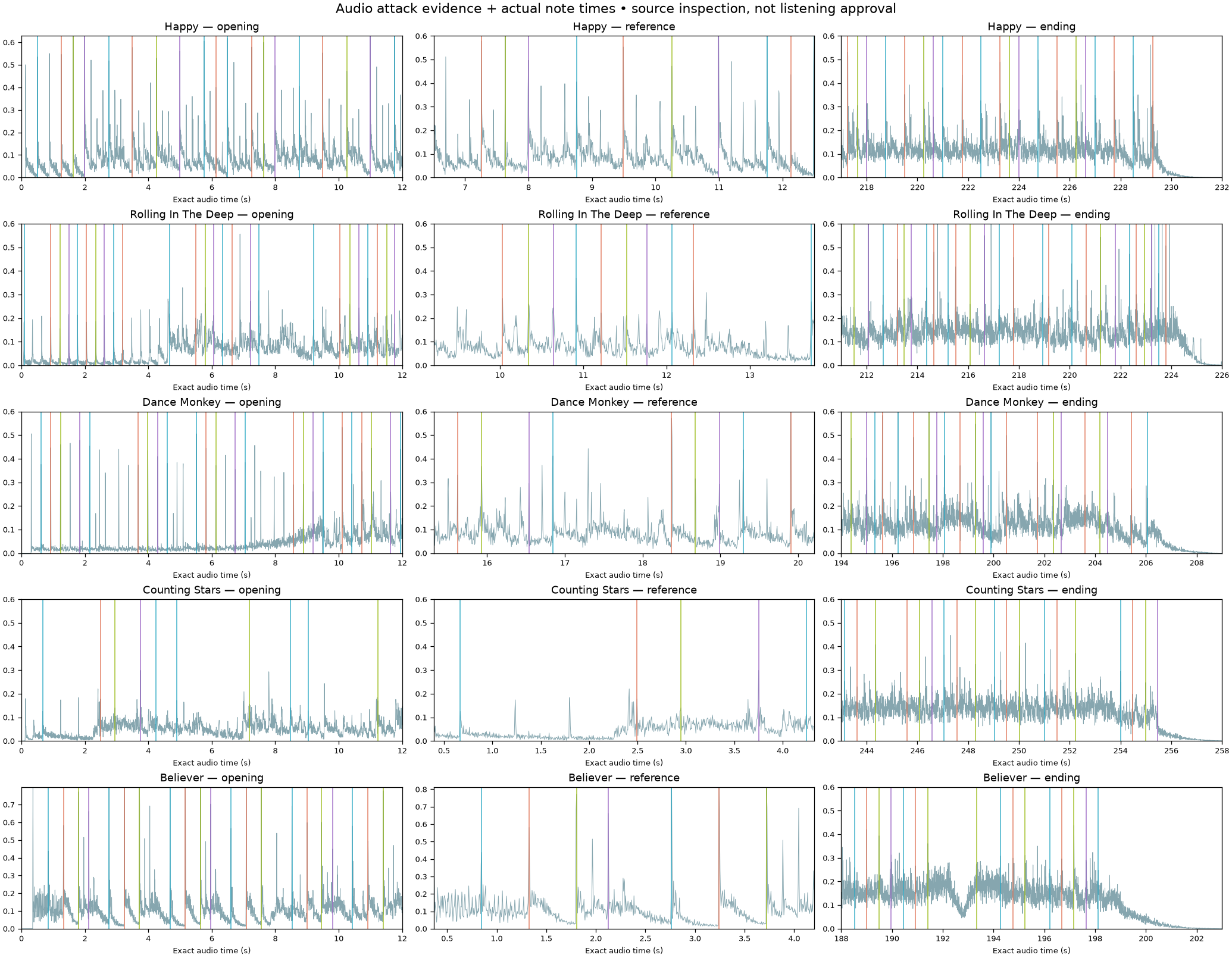
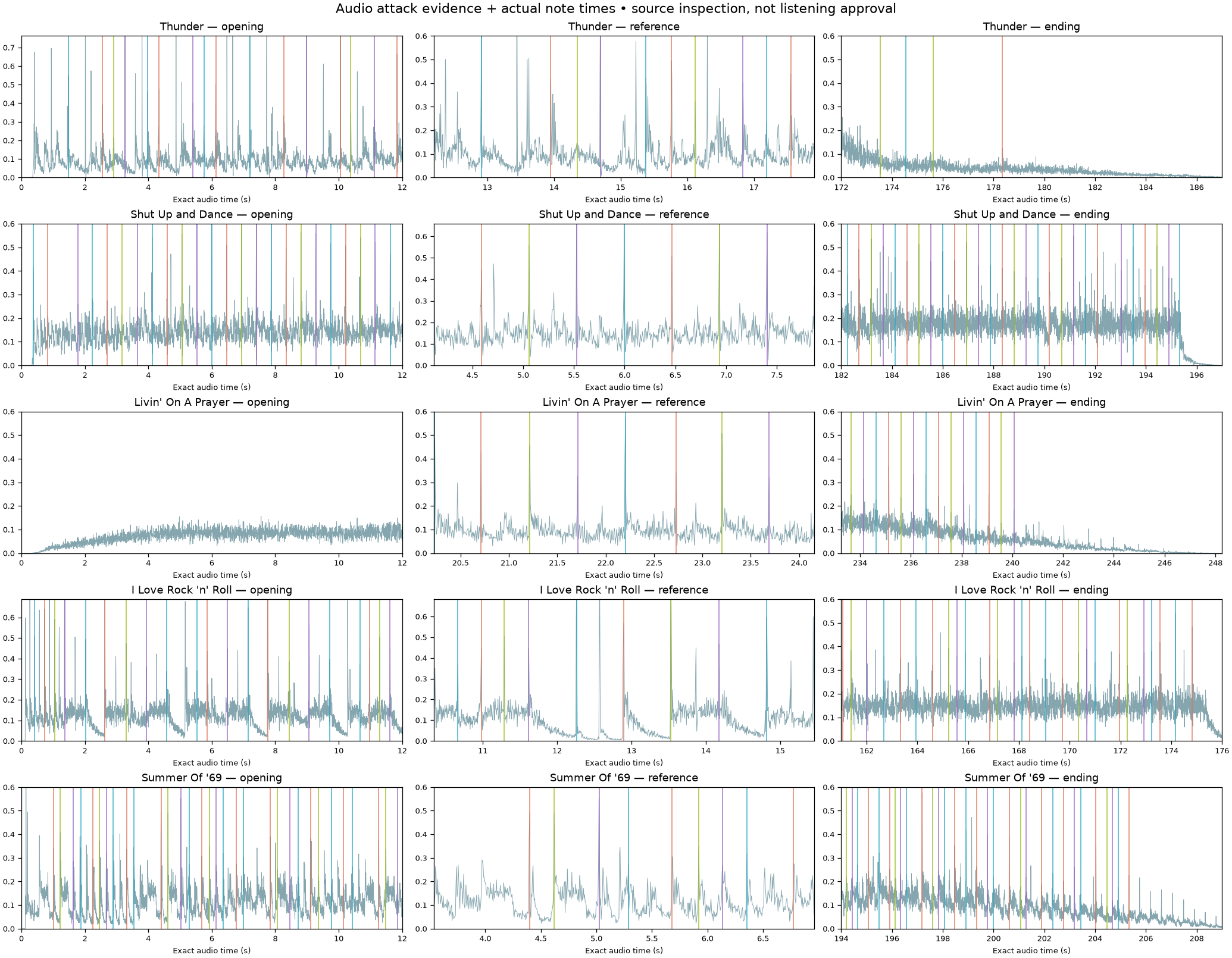
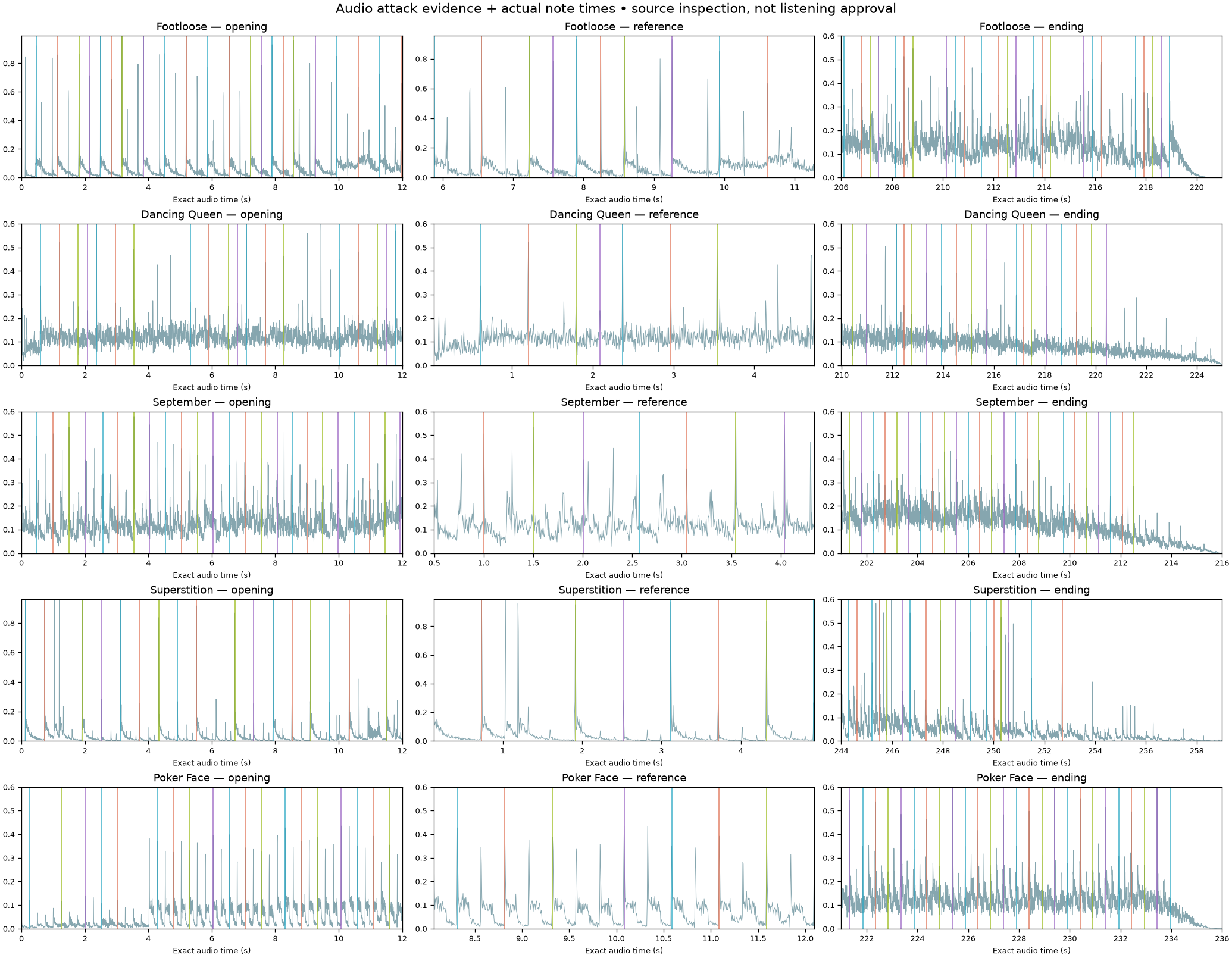
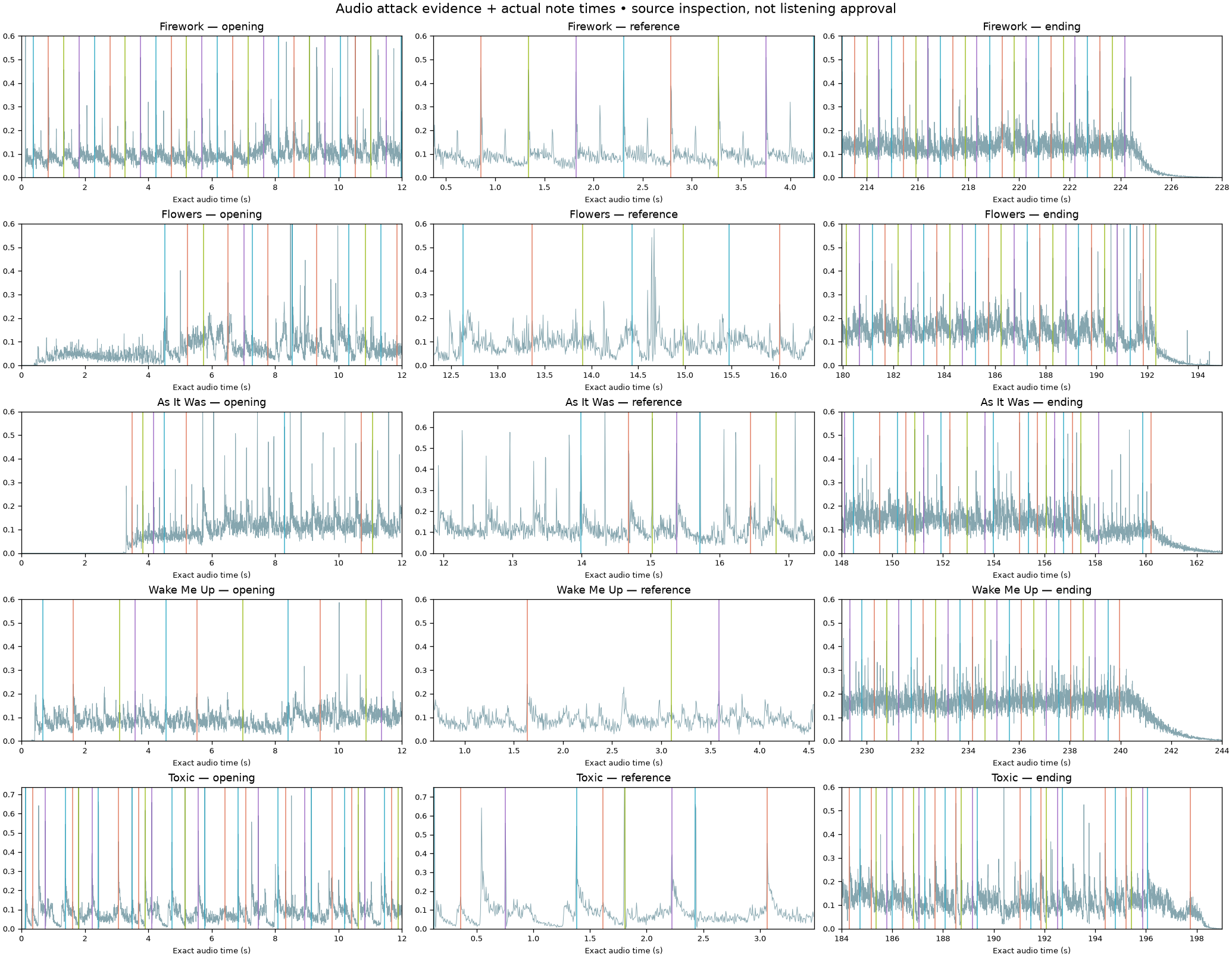
- Inspect opening, reference and ending plots for each song; revise weak intros, local tempo movement and unreliable pickups. Rebuild all 25 and compare each result with its first candidate.
- Validate each chart through the real Stingray provider, including current audio/MIDI fingerprints. Run all charts through the real scoring engine and check spacing, ordering, duration, references and review flags.
What is different about this batch
These are composite pulse-and-accent arrangements. The MIDI is used as a source and phrase reference and remains available for A/B comparison. This batch does not automatically combine every vocal syllable with every drum transient. All new groove notes are taps; instrument sustains are not invented. The six existing arrangements keep their authored riffs, holds and melody sections.
Blinding Lights, Levitating and Livin’ on a Prayer deliberately leave soft opening passages empty before clear attacks begin. As It Was preserves the initial silence in this particular recording. The measured duration of Livin’ on a Prayer is approximately 4:08 rather than the catalog's 4:20. September's opening needs a slower local pulse than its later sections.
Per-song results
The timing column is the 95th percentile of the local adjustment from a transported reference event to a measured peak. It is not a measurement of perceptual sync or TV latency. Early and late rests are deliberate where the source is quiet.
| Recording in the style of | Notes | Smallest gap | Timing adjustment · p95 | First note | Inspection and next review |
|---|---|---|---|---|---|
| Blinding Lights The Weeknd | 307 331 in first candidate | 314 ms | 4.0 ms | 12.67 s | Inspect this chartSoft opening has weak, non-repeating novelty before 11.6 s. Leave that build as a rest; begin on the clear attack train. Half-time pulse avoids dense 171 BPM eighths. 9 measured reference passages. 292 source MIDI notes inspected; these remain available as the vocal A/B comparison. 1.55 taps/s on average. Largest internal rest: 5.44 s. |
| Get Lucky Daft Punk | 433 444 in first candidate | 319 ms | 15.0 ms | 0.46 s | Inspect this chartOpening and outro have clear repeating attacks. Preserve the funk pulse; omit weak syncopations and stop with the fade rather than continuing a grid. 16 measured reference passages. 533 source MIDI notes inspected; these remain available as the vocal A/B comparison. 1.65 taps/s on average. Largest internal rest: 1.30 s. |
| Uptown Funk Mark Ronson feat. Bruno Mars | 584 592 in first candidate | 240 ms | 19.0 ms | 0.39 s | Inspect this chartBackbeat remains clear under the vocal. Keep a repeated gesture with a few measured pickups; no need to chart every vocal syllable. 17 measured reference passages. 676 source MIDI notes inspected; these remain available as the vocal A/B comparison. 2.16 taps/s on average. Largest internal rest: 1.08 s. |
| Levitating Dua Lipa | 379 395 in first candidate | 244 ms | 17.0 ms | 9.63 s | Inspect this chartQuiet opening before 8.73 s is not a strong tapping cue. Begin with the clear pulse; leave the quiet transition sparse. 11 measured reference passages. 665 source MIDI notes inspected; these remain available as the vocal A/B comparison. 1.88 taps/s on average. Largest internal rest: 4.37 s. |
| Shake It Off Taylor Swift | 349 351 in first candidate | 334 ms | 18.0 ms | 0.50 s | Inspect this chartUse an 80 BPM half-time feel. The onset plot supports repeated claps and optional pickups, without a 160 BPM stream. 9 measured reference passages. 640 source MIDI notes inspected; these remain available as the vocal A/B comparison. 1.61 taps/s on average. Largest internal rest: 3.76 s. |
| Happy Pharrell Williams | 380 381 in first candidate | 344 ms | 12.1 ms | 0.51 s | Inspect this chartUse half-time, with strong pulse and restrained pickups. Clear attacks continue into the ending and disappear with the fade. 10 measured reference passages. 605 source MIDI notes inspected; these remain available as the vocal A/B comparison. 1.64 taps/s on average. Largest internal rest: 0.79 s. |
| Rolling In The Deep Adele | 449 461 in first candidate | 240 ms | 29.6 ms | 0.09 s | Inspect this chartThe exposed opening has distinct attacks. Local pulse fitting follows the recording; retain weaker vocal-era moments as rests when contrast is insufficient. 13 measured reference passages. 507 source MIDI notes inspected; these remain available as the vocal A/B comparison. 1.99 taps/s on average. Largest internal rest: 1.73 s. |
| Dance Monkey Tones and I | 392 396 in first candidate | 269 ms | 20.4 ms | 0.62 s | Inspect this chartPiano opening provides distinct attacks. Keep a consistent pulse and local pickups, with space through the ending. 11 measured reference passages. 503 source MIDI notes inspected; these remain available as the vocal A/B comparison. 1.88 taps/s on average. Largest internal rest: 1.82 s. |
| Counting Stars OneRepublic | 386 432 in first candidate | 410 ms | 22.0 ms | 0.67 s | Inspect this chartOpening is much sparser than the full mix later. Prefer a smaller repeating pattern to filling every beat with vocal texture. 17 measured reference passages. 672 source MIDI notes inspected; these remain available as the vocal A/B comparison. 1.5 taps/s on average. Largest internal rest: 4.11 s. |
| Believer Imagine Dragons | 367 418 in first candidate | 280 ms | 22.0 ms | 0.85 s | Inspect this chartUse ternary subdivisions for the compound-feel pickups. Do not force them onto straight eighths; retain only peaks meeting the same onset threshold. 13 measured reference passages. 513 source MIDI notes inspected; these remain available as the vocal A/B comparison. 1.81 taps/s on average. Largest internal rest: 2.40 s. |
| Thunder Imagine Dragons | 293 291 in first candidate | 319 ms | 23.8 ms | 1.48 s | Inspect this chartComfortable 84 BPM pulse. The ending decays for several seconds; do not invent taps on the reverb tail. 8 measured reference passages. 300 source MIDI notes inspected; these remain available as the vocal A/B comparison. 1.57 taps/s on average. Largest internal rest: 2.74 s. |
| Shut Up and Dance WALK THE MOON | 394 408 in first candidate | 434 ms | 6.0 ms | 0.37 s | Inspect this chartDense guitar bed with recurring strong pulse attacks. A simple stable gesture reads more clearly than extra notes in the strumming texture. 14 measured reference passages. 406 source MIDI notes inspected; these remain available as the vocal A/B comparison. 2.0 taps/s on average. Largest internal rest: 0.95 s. |
| Livin' On A Prayer Bon Jovi | 412 466 in first candidate | 449 ms | 21.0 ms | 18.26 s | Inspect this chartThe swelling opening before 17.85 s lacks distinct repeated attacks in the inspected novelty plot. Keep it as a rest. Correct catalog duration using the actual recording; preserve only clear body attacks. 15 measured reference passages. 403 source MIDI notes inspected; these remain available as the vocal A/B comparison. 1.66 taps/s on average. Largest internal rest: 2.98 s. |
| I Love Rock 'n' Roll Joan Jett & the Blackhearts | 325 330 in first candidate | 285 ms | 26.0 ms | 0.42 s | Inspect this chartStomps and spaces alternate clearly. Do not fill the intentional gaps; no artificial sustains for percussion taps. 9 measured reference passages. 398 source MIDI notes inspected; these remain available as the vocal A/B comparison. 1.85 taps/s on average. Largest internal rest: 1.95 s. |
| Summer Of '69 Bryan Adams | 536 549 in first candidate | 190 ms | 28.2 ms | 1.02 s | Inspect this chartFaster and denser than most of this batch. Retain 190 ms minimum spacing and alternating thumbs; locally follow the slight tempo movement. 15 measured reference passages. 358 source MIDI notes inspected; these remain available as the vocal A/B comparison. 2.56 taps/s on average. Largest internal rest: 1.09 s. |
| Footloose Kenny Loggins | 404 405 in first candidate | 300 ms | 17.0 ms | 0.46 s | Inspect this chartHalf-time pulse at about 89 BPM gives clear large targets. Strong accents are regular through the ending. 11 measured reference passages. 328 source MIDI notes inspected; these remain available as the vocal A/B comparison. 1.83 taps/s on average. Largest internal rest: 1.35 s. |
| Dancing Queen ABBA | 400 453 in first candidate | 255 ms | 26.0 ms | 0.61 s | Inspect this chartFull mix has a dense bed. Require attack contrast; use the recorded local pulse instead of a rigid 101 BPM catalogue grid. 12 measured reference passages. 281 source MIDI notes inspected; these remain available as the vocal A/B comparison. 1.78 taps/s on average. Largest internal rest: 1.79 s. |
| September Earth, Wind & Fire | 438 402 in first candidate | 429 ms | 24.0 ms | 0.49 s | Inspect this chartOpening is slower than later sections. Widen local phrase tempo fitting; this restores the missed first two seconds without moving the final notes away from actual peaks. 14 measured reference passages. 398 source MIDI notes inspected; these remain available as the vocal A/B comparison. 2.03 taps/s on average. Largest internal rest: 0.97 s. |
| Superstition Stevie Wonder | 483 495 in first candidate | 244 ms | 28.0 ms | 0.12 s | Inspect this chartSyncopated opening has clear transient cues. Keep the funk gesture repeatable and leave weak late fade attacks out. 14 measured reference passages. 279 source MIDI notes inspected; these remain available as the vocal A/B comparison. 1.86 taps/s on average. Largest internal rest: 1.80 s. |
| Poker Face Lady Gaga | 451 455 in first candidate | 473 ms | 7.0 ms | 0.25 s | Inspect this chartVery stable electronic pulse. Preserve repeating hand positions; avoid decorating the long dense vocal sections with extra syllable taps. 15 measured reference passages. 498 source MIDI notes inspected; these remain available as the vocal A/B comparison. 1.91 taps/s on average. Largest internal rest: 2.02 s. |
| Firework Katy Perry | 431 460 in first candidate | 250 ms | 22.0 ms | 0.37 s | Inspect this chartOpening pulse and later build are distinct. Use local recording timing rather than trusting the catalogue 126 BPM figure. 15 measured reference passages. 440 source MIDI notes inspected; these remain available as the vocal A/B comparison. 1.89 taps/s on average. Largest internal rest: 1.93 s. |
| Flowers Miley Cyrus | 349 343 in first candidate | 260 ms | 13.6 ms | 4.51 s | Inspect this chartOpening has little transient definition until the vocal entrance around 4.5 s. Leave the introduction sparse; the later bass-and-drum pulse supports the main pattern. 12 measured reference passages. 358 source MIDI notes inspected; these remain available as the vocal A/B comparison. 1.79 taps/s on average. Largest internal rest: 1.35 s. |
| As It Was Harry Styles | 268 282 in first candidate | 325 ms | 11.3 ms | 3.48 s | Inspect this chartNo audible source before roughly 3.3 s. Keep that gap, use half-time, and avoid adding notes just to begin at zero. 8 measured reference passages. 275 source MIDI notes inspected; these remain available as the vocal A/B comparison. 1.64 taps/s on average. Largest internal rest: 3.10 s. |
| Wake Me Up Avicii | 375 433 in first candidate | 459 ms | 20.3 ms | 0.68 s | Inspect this chartAcoustic introduction and dance sections differ in texture. Prefer well-supported recurring accents and leave weak strums out; this is a composite groove, not guitar transcription. 16 measured reference passages. 293 source MIDI notes inspected; these remain available as the vocal A/B comparison. 1.54 taps/s on average. Largest internal rest: 3.38 s. |
| Toxic Britney Spears | 518 539 in first candidate | 190 ms | 19.0 ms | 0.12 s | Inspect this chartClear syncopated attacks but high tempo. Keep 190 ms minimum spacing; use recurring gestures and avoid dense sixteenth runs. 15 measured reference passages. 322 source MIDI notes inspected; these remain available as the vocal A/B comparison. 2.6 taps/s on average. Largest internal rest: 1.87 s. |
Functional verification completed
- 86 automated tests and JavaScript syntax checks pass, including all 31 full charts through the scoring engine.
- All 25 new charts verified against live Stingray audio and pitch-MIDI fingerprints.
- 75 chart/recipe/evidence files reproduced byte-for-byte from the saved numerical sources.
- Browser: title/artist search, combined filters, no-results reset, selected-song sync and back navigation. Mobile layouts checked at 430×932 and 932×430 without horizontal overflow.
- TV lobby at 1280×720: all ten recommendations, QR and four players fit above the footer. Background motion is hidden during gameplay.
- One complete 60-second September round with four simulated controllers: two scored all 122 notes, two intentionally missed. Ranking and music protection worked; playback time was reported to Stingray and no browser errors were observed.
Simulated input verifies the application and timestamp path. It is not a physical play-feel or independent listening test.
Reproduce and extend
The app contains charts/expansion-selection.json, a recipe and evidence file for each song, and charts/expansion-audit.json. The importer requires the authorized Stingray key in the process environment. Use a fresh evidence directory when refreshing sources; never save the key or signed URLs in the catalog. The runtime refuses changed source fingerprints.
PULSE_ANALYSIS_PYTHON=/path/to/analysis/python node scripts/import-expansion.mjs   /path/to/evidence charts/expansion-selection.json
/path/to/analysis/python scripts/build-expansion-charts.py   --selection charts/expansion-selection.json   --evidence /path/to/evidence --out /path/to/rebuilt-charts
npm run check
npm test
Feature extraction currently uses NumPy, SciPy and macOS afconvert. The same numeric features reproduce the same files. A different decoder or new recording needs a fresh inspection. Reference selection remains a candidate-authoring aid, not automatic musical approval.
Listening approval for the next release
For each track, play the stored reference, opening, middle and ending presets with the music and rhythm click together, then the music alone. Check that taps describe a recognisable musical part, repeats keep their gesture, and transitions feel intentional. Test quick and full rounds on a physical phone while watching the TV, then multiplayer. Record the listener, device, browser, offsets and exceptions. Mark a chart approved only after those results are recorded; do not infer approval from a good numeric score.
Library and TV
The phone searches song titles and artists, ignoring case, punctuation and accents. Genre and song-length filters combine with the query, include a result count and a reset action, and persist when returning from round setup. The TV shows ten varied recommendations during the lobby, the selected track and the party roster. Background light moves slowly in the lobby, stops during gameplay and respects reduced-motion preferences. No autoplay previews are added while searching.
Signal inspection sheets
The plots helped identify weak openings, overly dense passages and local tempo movement. They show numeric attack evidence, not isolated instruments or a listener’s judgement.